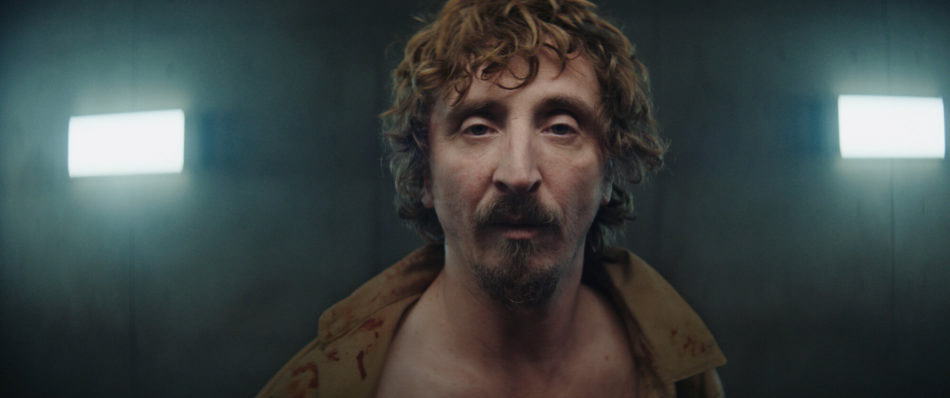
[Netflix] “The Platform” and the Mirror of Contemporary Society
April 10, 2020
Sofía Alvarez Salas
April 10, 2020
Sofía Alvarez Salas
The Platform (El hoyo) is the debut feature film by Basque director Galder Gaztelu-Urrutia. This is arguably the quarantine movie of the moment. But why?
The Platform introduces us to a dystopian world where people enter a kind of prison voluntarily—whether they've committed a crime or not. This “hole” consists of countless levels stacked vertically, with a platform that descends once a day carrying a banquet. No one knows how many levels there are, nor whether the food will make it down to them.
Much like in real life, the level you’re placed on is purely random. One month you could be on level 8, and the next on 205—where your sanity will be put to the test. Two people share each level and must coexist until one dies or is removed—but as far as we see, no one ever leaves.
The Platform works as a metaphor for social class differences. Everyone could potentially be at the top or the bottom. Those at the top have no trouble accessing food, while those below are left with nothing and must commit unspeakable acts to survive.
The system is structured so that there’s enough for everyone—if only each person took only what they needed. But, as we know all too well, that’s never how things work.
It feels eerily familiar—a world with enough resources for all, yet the vast majority are hoarded by the few at the top, forcing those below into inhumane struggles for survival.
Goreng is our guide through this story, a man who enters the hole to earn a diploma. He brings a book with him: Don Quixote de la Mancha. Others bring vastly different items—knives, guns, even dogs. It’s easy to empathize with someone like Goreng, who believes himself incapable of the atrocities others commit under confinement. But Gaztelu-Urrutia's perspective takes us elsewhere: all humans, when pushed to survive, will do terrible things—and find ways to justify them. We see this over and over in the film. The more hopeful characters shatter when faced with the brutal, vertical jungle that is The Platform. Only those willing to do whatever it takes—especially at the expense of others—will survive.
The film maintains a pessimistic view of humanity. Every time a character attempts kindness or altruism, The Platform swiftly punishes them. The system enforces order, but that order only makes sense to a few. This becomes especially clear when we’re shown the chefs, who prepare meals with obsessive precision—even though their food ends up in the hands of starving prisoners who haven’t eaten in days or months.
The film clearly draws inspiration from Dante Alighieri’s Divine Comedy. The hole’s levels are like descending circles of hell—more difficult and indifferent the lower you go. How does one beat such a system? Goreng plans to wait for release, but as his cellmates change, it becomes clear that no one ever leaves. We're told people exit The Platform, but we never see it happen—we only see what people become.
A particularly fascinating metaphor arises through the character of Miharu, a woman who rides the platform every month in search of her daughter—even though we’re told that no one under 16 is allowed in the hole, and others claim she entered alone.
She violently defends herself against anyone who touches her. We truly are in Dante’s inferno. Miharu's unrelenting violence and resilience strike us again and again. Yet Goreng feels some empathy for her, despite her apparent madness and the impossibility of her quest.
The film operates entirely through symbols. Miharu becomes the embodiment of justice taken into one’s own hands—violence returned upon the system that created it. She represents the vengeance of the oppressed. Everyone fears her or tries to hurt her, but she always prevails. She is the system attacking itself.
You cannot beat the system by mirroring its violence. Goreng joins Baharat, a diehard optimist who quickly gets a harsh dose of reality. Together, they imagine a way to fight back—a plan that would require cooperation across all levels of the hole.
Of course, most people don’t want to cooperate. So they resort to force—until a wise man reminds them that persuasion must come before violence. They apply this and succeed with some levels. Riding the platform downward, they attempt to ration food in hopes it will reach everyone—based on their assumptions of how many levels there are. But there are more. They encounter levels that haven’t eaten in a month. What they find is horrifying: the worst of what a desperate human being is capable of. Still, they carry a symbol that could communicate the system’s failure to its creators.
Until they find the true symbol—and this is where opinions on the film’s ending diverge.
What does the ending mean?
There’s no doubt Gaztelu-Urrutia wants us to ask this question—and watch the film more than once. The final scenes suggest a deep reflection on division: there are those at the top and those at the bottom. Both commit atrocities. But then, there’s a third option: the possibility of a different future—an unwritten one, untainted by humanity’s darkest impulses. Only that future, and that alone, can rise on the platform and offer us a chance to change course.
As I mentioned earlier, Gaztelu-Urrutia paints a pessimistic view of humanity—and I think he succeeds in doing so with this debut feature. The film benefits from multiple viewings to catch its many layers, character dynamics, and symbolic meanings. In the end, without realizing it, we too are part of The Platform.